

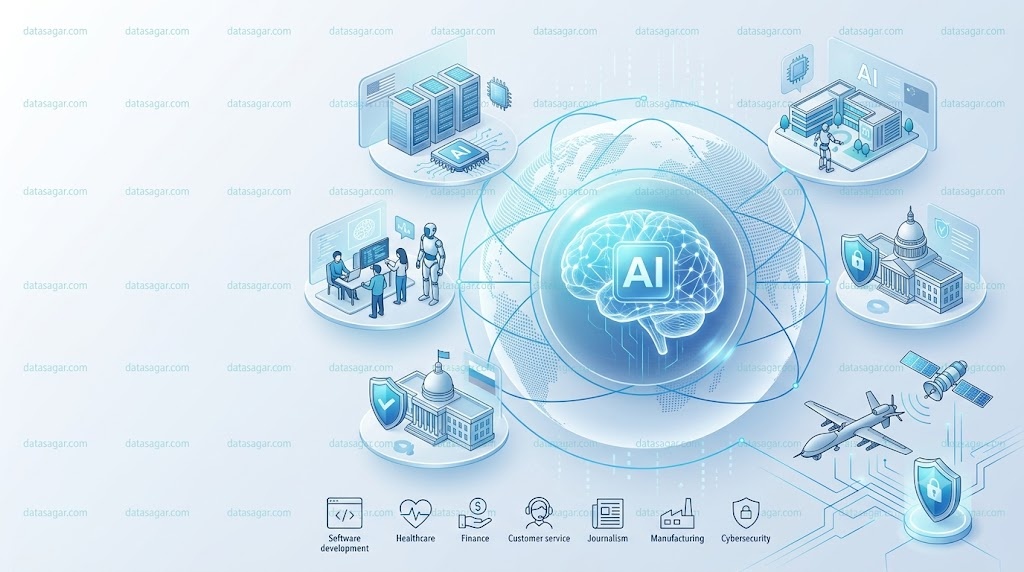
Artificial Intelligence (AI) is advancing faster than almost any technology in history. Every few months, new AI models become more capable of writing software, generating realistic videos, diagnosing diseases, conducting scientific research, and automating tasks that once required human expertise.
This rapid progress has sparked an important global debate:
Should governments slow down AI development, or should innovation continue without major restrictions?
The question is no longer hypothetical. More than 1,100 researchers and employees from OpenAI, Anthropic, Google, Meta, Microsoft, and other leading AI organizations recently urged the Trump administration to support international safeguards for frontier AI. Their concern is simple but significant: AI capabilities may be advancing faster than governments, regulators, and society can safely understand and manage.
Rather than calling for an end to AI innovation, these experts advocate for responsible governance, stronger safety standards, and international cooperation before increasingly powerful AI systems become difficult to control.
What Is Frontier AI?
Frontier AI refers to the most advanced artificial intelligence systems currently under development. These models represent the cutting edge of AI capabilities and are designed to solve increasingly complex problems.
Unlike traditional AI applications that perform specific tasks, frontier AI systems can:
- Write and debug computer software
- Generate high-quality images and videos
- Perform advanced scientific reasoning
- Assist in medical research
- Analyze massive datasets within seconds
- Translate languages with remarkable accuracy
- Support autonomous robotics
- Conduct complex strategic planning
Researchers are particularly concerned that future frontier AI systems could eventually assist in designing and improving newer AI models, accelerating development beyond the pace of human oversight.
Why Are AI Experts Raising the Alarm?
The warning does not suggest that AI is inherently dangerous.
Instead, experts worry that the competition to build more powerful AI systems is moving faster than the development of safety standards, regulations, and oversight.
Today, governments and technology companies are engaged in a global race to become AI leaders.
Every major breakthrough creates pressure on competitors to release even more capable models.
When innovation outpaces governance, important questions remain unanswered:
- How should powerful AI models be tested before public release?
- Who is accountable if an AI system causes significant harm?
- How can governments prevent misuse by cybercriminals or hostile nations?
- What happens if AI begins accelerating its own development?
These are the questions motivating calls for international AI governance.
Frontier AI Development Around the World
Artificial intelligence has become a strategic priority for many nations.
United States: Leading the Frontier AI Race
The United States remains home to many of the world’s most advanced AI companies, including OpenAI, Anthropic, Google DeepMind, Meta, Microsoft, and xAI.
American frontier AI systems now assist software developers, healthcare professionals, researchers, educators, lawyers, marketers, and financial analysts.
AI coding assistants, for example, now generate significant portions of software code, transforming how developers work and reducing the time needed for routine programming tasks.
The U.S. government is simultaneously encouraging AI innovation while expanding efforts to improve AI safety, cybersecurity, and national security.
China: AI as National Strategy
China views artificial intelligence as a cornerstone of future economic and geopolitical power.
Major Chinese companies such as DeepSeek, Alibaba (Qwen), Tencent (Hunyuan), Baidu (ERNIE), and Zhipu AI have rapidly developed competitive frontier AI models.
China is deploying AI across:
- Manufacturing
- Industrial automation
- Smart cities
- Healthcare
- Education
- Financial services
- Surveillance technologies
- Military modernization
Large-scale automation is helping increase industrial productivity while reducing dependence on repetitive human labor.
Europe: Innovation with Regulation
Unlike the United States and China, Europe has prioritized responsible AI governance.
The European Union’s AI Act is one of the world’s first comprehensive legal frameworks for regulating artificial intelligence.
European AI companies such as Mistral AI continue developing advanced language models while emphasizing transparency, accountability, privacy, and human oversight.
Europe’s approach demonstrates that technological innovation and regulation can coexist.
Russia: AI for Security and Defense
Russia continues investing heavily in artificial intelligence for cybersecurity, defense technologies, autonomous military systems, intelligence analysis, and language processing.
Technology companies such as Yandex have expanded AI applications across search, navigation, cloud services, autonomous driving, and machine translation.
As geopolitical competition intensifies, AI is increasingly viewed as a strategic national asset rather than simply a commercial technology.
India: Building AI for Scale and Strategic Independence
India has rapidly emerged as one of the world’s fastest-growing AI ecosystems. While it may not yet match the frontier AI capabilities of the United States or China, the country is making significant investments in AI research, digital infrastructure, and homegrown foundation models.
Government initiatives such as the IndiaAI Mission aim to strengthen computing infrastructure, support AI startups, develop indigenous language models, and promote responsible AI innovation. At the same time, Indian technology companies like Infosys, Tata Consultancy Services (TCS), Wipro, and Tech Mahindra are integrating AI into enterprise software, healthcare, finance, manufacturing, agriculture, and public services.
India is also witnessing a surge in AI startups building solutions for education, agriculture, healthcare diagnostics, logistics, and governance. With one of the world’s largest pools of software engineers and a rapidly expanding digital economy, India is positioning itself as a major AI innovation hub.
However, like many other nations, India faces important challenges. AI-driven automation could significantly affect the country’s large IT outsourcing and business process outsourcing (BPO) industries, where routine coding, customer support, and back-office operations are increasingly being assisted—or in some cases replaced—by generative AI systems. Balancing innovation with workforce reskilling will be critical as AI adoption accelerates.
How Artificial Intelligence Is Transforming Modern Warfare
Artificial intelligence is reshaping warfare just as profoundly as it is transforming civilian industries. Militaries around the world increasingly view AI as a strategic capability that can improve decision-making, accelerate operations, and enhance national security.
Rather than replacing soldiers entirely, AI is becoming a powerful force multiplier that assists human operators in analyzing information and responding more quickly to evolving threats.
AI-Powered Surveillance and Intelligence
Modern militaries process enormous volumes of data from satellites, drones, radar systems, and surveillance cameras. AI can analyze these data streams in real time, identifying unusual activity, tracking troop movements, detecting military equipment, and providing intelligence far faster than human analysts alone.
Autonomous and Semi-Autonomous Drones
AI enables drones to navigate complex environments, avoid obstacles, recognize targets, and coordinate with other unmanned systems. Although many countries still require human authorization before using lethal force, increasing levels of autonomy are changing how surveillance and combat missions are conducted.
The conflict in Ukraine has demonstrated how AI-assisted drones, image recognition, and autonomous navigation are becoming integral parts of modern battlefields.
Cyber Warfare
AI has become a critical tool for both cyber defense and cyber offense.
Defenders use AI to detect network intrusions, identify malware, and respond to cyberattacks within seconds. At the same time, attackers can use AI to automate phishing campaigns, generate convincing fake content, identify software vulnerabilities, and develop increasingly sophisticated cyber threats.
This creates an ongoing technological race between offensive and defensive cyber capabilities.
Battlefield Decision Support
Military commanders increasingly rely on AI to process intelligence from multiple sources, simulate potential outcomes, recommend logistical strategies, and optimize resource allocation. Rather than making final decisions, these systems help human leaders evaluate options more quickly in high-pressure situations.
AI and Information Warfare
Generative AI has introduced new challenges in the information domain. Deepfake videos, AI-generated audio, and synthetic images can be used to spread misinformation, impersonate public officials, manipulate public opinion, or undermine trust during conflicts.
As these technologies become more realistic, distinguishing authentic information from fabricated content becomes increasingly difficult.
The Global Military AI Race
Several major powers are investing heavily in military AI:
- United States: Developing AI for intelligence analysis, autonomous systems, logistics, cybersecurity, and decision support through collaborations between the Department of Defense and private technology companies.
- China: Integrating AI into military modernization, autonomous platforms, surveillance, electronic warfare, and strategic decision-making.
- Russia: Investing in AI-enabled defense technologies, autonomous systems, intelligence gathering, and electronic warfare capabilities.
- India: Expanding the use of AI for border surveillance, maritime security, drone technology, logistics, cybersecurity, and defense research through organizations such as the Defence Research and Development Organisation (DRDO) and collaborations with domestic technology firms.
- European nations: Increasing investment in AI for defense while emphasizing compliance with international law, ethical standards, and human oversight.
Why Military AI Raises Global Concerns
The rapid adoption of AI in defense has raised difficult ethical and geopolitical questions:
- Should autonomous weapons be allowed to make life-and-death decisions?
- How can countries prevent an uncontrolled AI arms race?
- Who is accountable if an AI-assisted military system makes a fatal mistake?
- Can international agreements establish meaningful limits on military AI development?
Unlike previous technological revolutions, AI is advancing simultaneously across civilian, commercial, and military sectors. This makes global cooperation especially challenging, as nations seek both technological leadership and national security advantages.
For many experts, the issue is not whether AI will become part of future warfare—it already has. The more pressing question is whether governments can establish international norms and safeguards before increasingly autonomous military systems outpace the rules designed to govern them.
Governments worldwide are investing in AI-powered:
- Cybersecurity systems
- Intelligence gathering
- Military planning
- Autonomous drones
- Satellite surveillance
- Critical infrastructure protection
- Disaster response
However, the same technology can also be exploited for malicious purposes.
Potential risks include:
- AI-generated cyberattacks
- Deepfake misinformation campaigns
- Automated phishing scams
- AI-assisted hacking
- Synthetic identity fraud
- Autonomous weapon systems
These concerns have elevated AI from a technology issue to a national security priority.
How Frontier AI Is Already Changing Jobs
AI is no longer expected to change the workforce someday—it is already doing so.
Industries experiencing rapid transformation include:
- AI tools now automate routine coding, document analysis, customer support, report writing, image creation, and data processing.
While these technologies significantly improve productivity, they also reduce demand for many repetitive and entry-level tasks.
History suggests that technological revolutions create new careers while making others obsolete. The challenge lies in helping workers adapt through education and reskilling.
Should Governments Slow Down AI Development?
Completely halting AI development is unlikely to be practical.
If one country slows research while another accelerates, technological leadership may simply shift elsewhere.
Instead of stopping AI altogether, many experts recommend responsible acceleration supported by global governance.
Possible policy measures include:
- Independent safety testing before releasing frontier AI models
- International cooperation among leading AI nations
- Transparent reporting of AI capabilities
- Cybersecurity standards for AI systems
- Clear legal accountability
- Public investment in workforce retraining
- Ethical guidelines for high-risk AI applications
This approach allows innovation to continue while reducing unnecessary risks.
Final Thoughts
Artificial intelligence could become one of humanity’s greatest technological achievements.
It also has the potential to become one of humanity’s greatest governance challenges.
The warning from more than 1,100 AI researchers deserves attention because it comes from individuals directly involved in building these systems.
Their message is not to stop innovation.
It is to ensure that technological progress remains aligned with public safety, human values, transparency, and democratic oversight.
The future of AI will likely depend not only on how quickly we build smarter machines—but also on how wisely we choose to govern them.
Frequently Asked Questions (FAQ)
What is Frontier AI?
Frontier AI refers to the most advanced artificial intelligence systems capable of performing complex reasoning, scientific research, software development, and multimodal tasks beyond traditional AI applications.
Why do some experts want governments to regulate AI?
Researchers believe AI capabilities are advancing faster than governments can establish safety standards, accountability, and oversight mechanisms.
Which countries lead AI development?
The United States and China currently lead frontier AI development, while Europe focuses heavily on AI regulation and responsible innovation. Russia is investing significantly in AI for defense, cybersecurity, and strategic technologies.
Will AI replace human jobs?
AI is expected to automate many repetitive and routine tasks while creating new opportunities in AI engineering, cybersecurity, robotics, education, healthcare, and digital services. The overall impact will depend on workforce adaptation and reskilling.
You May Also LIke
- What Is Artificial Intelligence (AI)?
- Top AI Tools Every Professional Should Know
- The Future of Cybersecurity in the Age of AI
- Ethical Challenges of Artificial Intelligence
- What Is Machine Learning? AI vs Machine Learning Explained