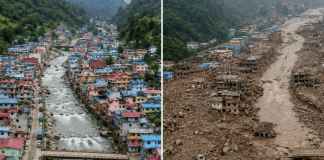

A rigorous empirical breakdown of the August 2026 Third Pole cryosphere collapse, official NDRRMA statistics, and the economic reality of Himalayan climate vulnerability.
Rasuwa Flash Flood Trigger and Mechanism
According to official data released in Situation Report #6 by the National Disaster Risk Reduction and Management Authority (NDRRMA), the crisis unfolded on August 26, 2026 (Bhadra 10, 2083 BS). A massive 1 square kilometer ice and rock avalanche collapsed in the upper northern region of Lhendi Khola near the Nepal-China border.
The high-altitude slope failure generated seismic signals equivalent to a magnitude 5.2 earthquake, unleashing catastrophic flash floods down the Bhotekoshi and Trishuli river basins.
Total Estimated Loss and Casualties in Rasuwa Flood
Official post-disaster body recovery operations coordinated across downstream river corridors have documented a severe human toll:
Total Recovered Bodies: 389
- Chitwan: 137 bodies
- Nawalparasi East: 87 bodies
- Dhading: 33 bodies
- Gorkha: 30 bodies (including various human body parts)
- Nuwakot: 28 bodies
- Tanahu: 28 bodies
- Nawalparasi West: 27 bodies
- Rasuwa: 17 bodies
Missing Numbers in Rasuwa Flood and Institutional Breakdown
The registry of missing individuals spans civil administration, security personnel, and international travelers:
Total Unaccounted Missing: 977 Persons
- Foreign Nationals: 517 persons
- Rasuwa District (DEOC Reports): 161 persons
- Non-Resident / Touring Nepali Citizens: 127 persons
- Makwanpur District (DEOC Reports): 66 persons
- Nepal Army Personnel: 44 personnel
- Nepal Police Personnel: 28 personnel
- Customs Office Staff: 15 personnel
- Armed Police Force (APF): 13 personnel
- Immigration Office Staff: 4 personnel
- Nuwakot District (DEOC Reports): 1 person
International Missing Registry (Nepal Tourism Board Data)
Data compiled by the Nepal Tourism Board (NTB) details missing foreign nationals and travelers caught in the northern corridor:
- India: 178 missing
- USA: 65 missing
- Ukraine: 53 missing
- Malaysia: 51 missing
- Australia: 35 missing
- United Kingdom: 33 missing
- Canada: 25 missing
- Other Nationalities: Russia (8), Germany (8), Singapore (9), South Africa (6), France (4), Japan (5), New Zealand (5), Spain (3), Belgium (3), Italy (2), Ireland (2), Kazakhstan (2), Portugal (2), Netherlands (2), and single-digit counts across European and Asian nations (totaling 644 registered via NTB metrics).
Satellite Analysis warns The 18km Upstream Debris Lake Risk
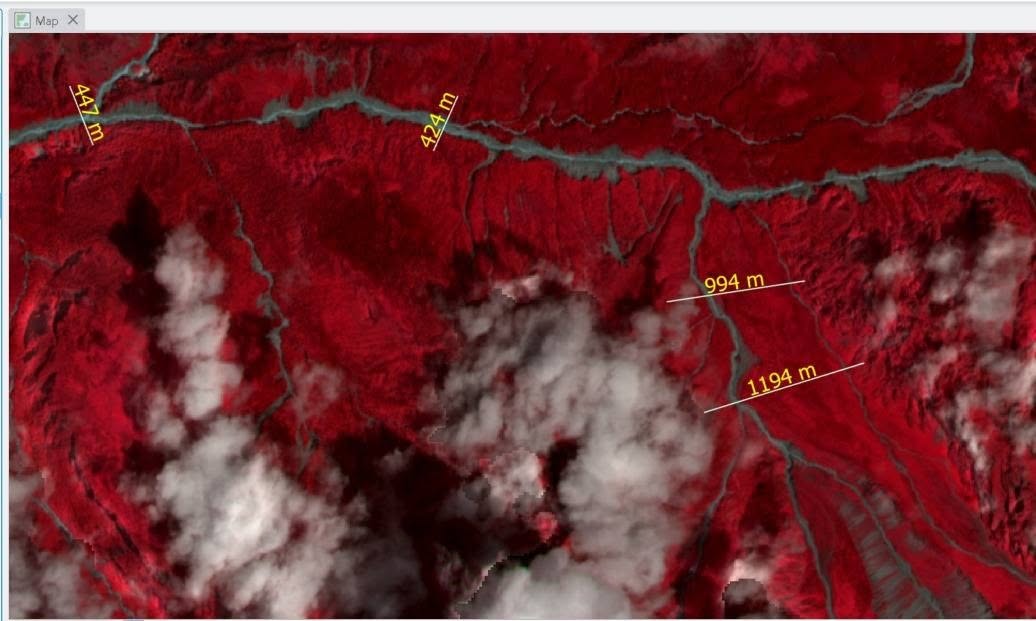
Preliminary analysis of satellite imagery captured on Bhadra 11 at 11:44 AM indicates that roughly 18 kilometers upstream from Rasuwagadhi, the Lhendi Khola channel is obstructed by heavy landslide debris. This blockage has formed an artificial lake spanning approximately 0.11 square kilometers.
Because the structural integrity of this natural dam remains unstable, NDRRMA has warned downstream settlements that secondary barrier breaches could trigger subsequent flash floods.
Nepal Flood Relief Efforts and Government Allocation
Search and rescue mobilizations have deployed 13,295 security personnel (7,250 Nepal Police, 4,200 Nepal Army, and 1,845 APF). Aerial operations utilizing 15 helicopters have successfully evacuated 1,976 individuals.
Immediate cash grants disbursed by the federal government total Rs 2.5 Crore (Rs 1 Crore to Rasuwa, Rs 1 Crore to Nuwakot, and Rs 50 Lakhs to Dhading). Furthermore, the Ministry of Finance has operationalized a Single-Window Relief Collection System (एकद्वार प्रणाली) under the Prime Minister’s Disaster Relief Fund for domestic and international donations.
Nepal emits a negligible fraction of global greenhouse gases, yet mountain watersheds bear the brunt of industrial climate breakdown. When transboundary cryosphere collapses wipe out billions in infrastructure and claim hundreds of lives, financial recovery cannot depend on international charity or sovereign debt. Climate finance is a direct, non-negotiable debt owed by global industrial emitters to the vulnerable communities of the Hindu Kush–Himalaya.