
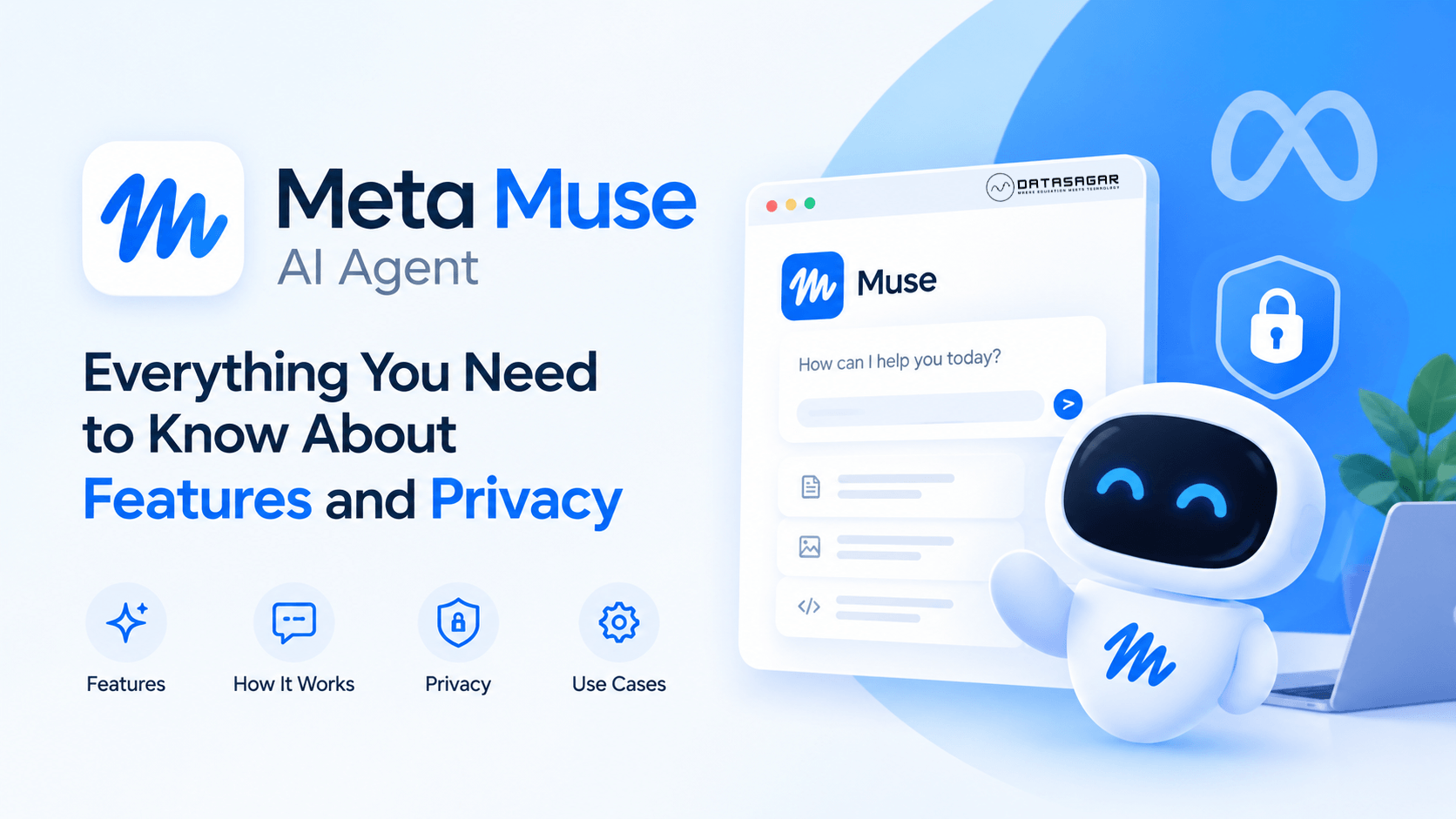
Artificial intelligence is shifting gears rapidly. We are moving away from passive chatbots that wait for prompts, stepping instead into an era of autonomous digital workflows. A major milestone dropped recently when Meta announced Muse, a personal AI agent designed to understand human goals and execute complex tasks 24/7 across health, home management, and relationship building.
The debut of Muse highlights a broader technical evolution. AI is no longer just a text generator answering trivia. It functions more like a digital operator capable of using external capabilities, executing loops, and solving problems independently. Understanding this shift requires looking closely at how modern machine learning models operate under the hood, much like foundational concepts explored in our breakdown of beginner-friendly AI and data science roadmaps.
What Makes Muse Different from Standard Chatbots
Traditional AI assistants require constant human steering. You ask a question, read the text, and manually perform any follow-up actions. Muse changes the operational loop by acting proactively. According to the product announcement video, users can deploy the agent to coordinate family projects, monitor training metrics, manage subscription spending, and plan complex travel itineraries without micro-management.
This capability places Muse squarely in the category of advanced autonomous systems. Instead of just spitting out code or ideas, an agent evaluates a goal, breaks it down into steps, and interacts with third-party software environments. Developers tracking these capabilities often study how underlying architectures handle sequential reasoning, APIs, and decision loops.
Security, Virtual Machines, and Privacy Controls
Granting an artificial intelligence agent access to personal life details, credit cards, and communications introduces massive security hurdles. To combat privacy fears, Meta engineered the Muse Secure Virtual Machine. This acts as an isolated private computer dedicated solely to an individual agent and their data.
Furthermore, sensitive credentials like passwords and credit card details live in a secured credential store where the base model cannot read them directly. The system also implements a confirmation checkpoint. Muse must pause and ask for explicit user approval before executing sensitive operations like transferring funds or broadcasting messages. For users demanding maximum confidentiality, Meta modeled its end-to-end encryption standards after WhatsApp protocols, ensuring even the platform provider cannot peek into private agent sessions.
The Token Economy and Personal Superintelligence
Meta is rolling out Muse with a freemium model. Users gain access for free up to one hundred million tokens per week, with subscription tiers available for heavier power users. Meta leadership views this launch as the foundational first step toward building true personal superintelligence.
As generative models grow more capable, the barrier between consumer software and autonomous task execution continues to shrink. Keeping pace with these fast-moving paradigms requires a strong grasp of core machine learning fundamentals, data engineering, and neural network behaviors. Readers interested in building foundational technical skills can explore structured guides and resources on our platform, including our overview of essential machine learning and artificial intelligence curriculums.
What the Rise of AI Agents Means for the Future
The introduction of autonomous consumer agents marks a turning point in how humans interact with software. As systems like Muse transition from novelty tools to daily life operators, digital privacy, secure execution sandboxes, and token management will dominate tech discourse.
Whether you are a software developer building local automation scripts or an end-user organizing daily schedules, the era of agentic artificial intelligence has arrived. Staying informed on these breakthroughs is critical for navigating the next decade of technology evolution.