

Imagine launching a software project at 21 with zero venture capital, no startup accelerator, no fancy office, and no marketing budget.
Now imagine publicly declaring that your project was “just a hobby, won’t be big and professional.”
On August 25, 1991, Finnish computer science student Linus Torvalds posted an unassuming announcement to the comp.os.minix Usenet newsgroup:
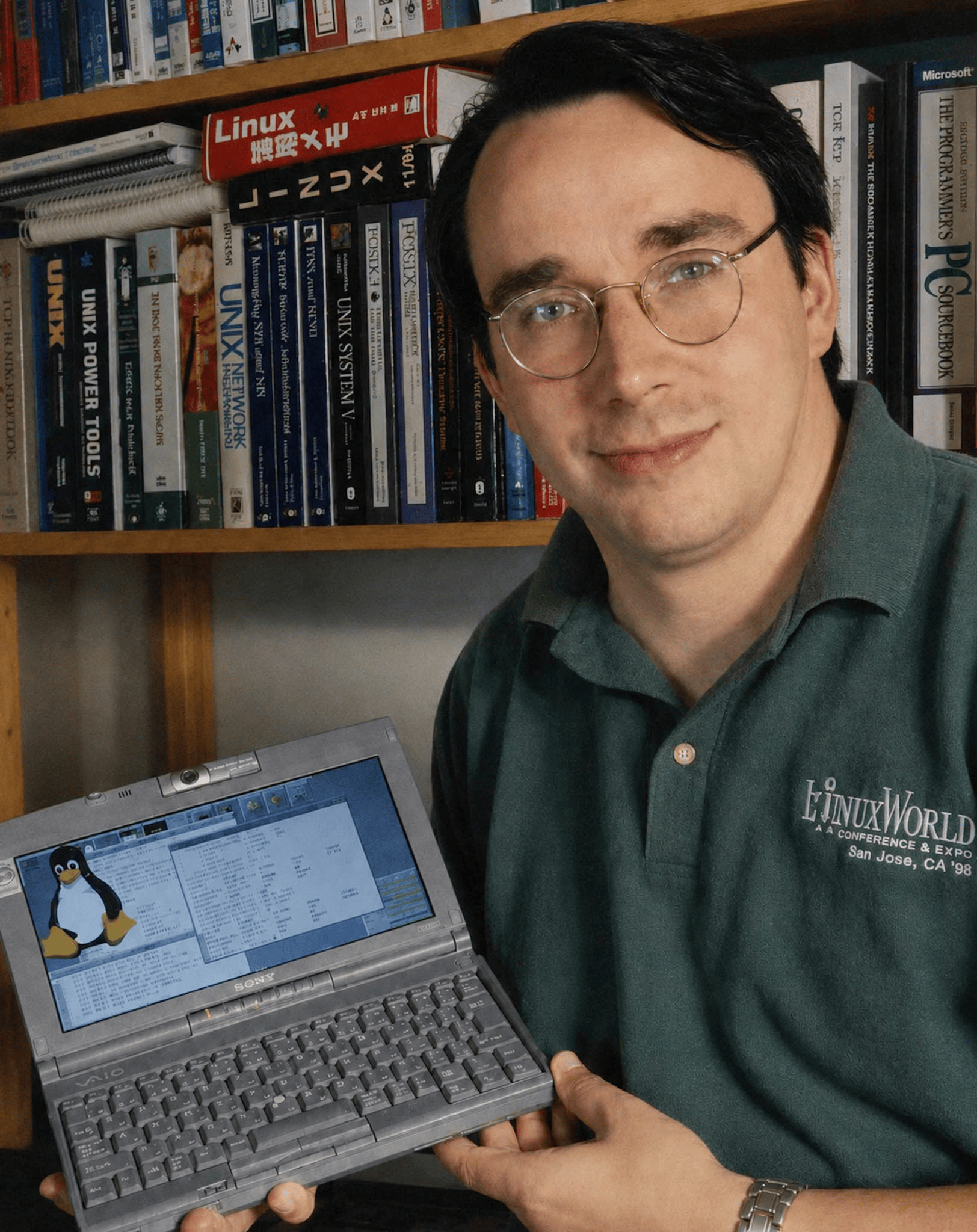
“I’m doing a (free) operating system (just a hobby, won’t be big and professional like gnu) for 386(486) AT clones. This has been brewing since april, and is starting to get ready. I’d like any feedback on things people like/dislike in minix, as my OS resembles it somewhat…”
There was no GitHub, no Stack Overflow, no ChatGPT, and no cloud computing. There was only a student, a 386 PC, an ambitious technical problem, and an internet newsgroup willing to experiment.
Thirty-five years later, that “hobby” forms the invisible backbone of modern civilization.
Visual Timeline: The Journey of Linus Torvalds
From a university bedroom in Helsinki to powering global infrastructure.
Born in Helsinki, Finland
Named after chemist Linus Pauling. He developed an early passion for programming, practicing on his grandfather’s Commodore VIC-20.
Enters University of Helsinki
Enrolls in computer science. His studies were paused for 11 months of mandatory military service in the Finnish Navy before returning to code.
The Usenet Announcement
At age 21, Linus posts his famous message to comp.os.minix announcing a free “hobby” operating system kernel for 386 AT clones.
Adopts GPLv2 License
Relicenses the Linux kernel under GPLv2, combining forces with the GNU Project and laying the foundation for the open-source economy.
Move to Silicon Valley (Transmeta)
Moves to the US to work for Transmeta, negotiating a contract that allowed him to continue maintainer duties on Linux full-time.
Invents Git
Frustrated by existing version control systems while coordinating thousands of kernel patches, Linus builds Git in a single week.
The Linux Foundation Fellow
Joins The Linux Foundation full-time. He remains the principal maintainer and final authority over the Linux kernel code.
Active Chief Maintainer
Linus continues to oversee kernel releases that power billions of Android phones, cloud servers, supercomputers, and space missions.
The Harsh Reality: Why Linus Didn’t Build Linux “Alone”
The myth of the lone genius coding an entire operating system in a dark room makes for great social media storytelling, but it ignores the real lesson of software engineering.
Linus wrote the original kernel foundation (version 0.01 released in September 1991 had roughly 10,000 lines of code). But Linux survived and scaled because of two critical factors:
- The Existing GNU Ecosystem: Linus built the kernel, but he relied on Richard Stallman’s GNU project for vital components like the GCC compiler, Bash shell, and core C libraries. Without GNU, Linux was just an engine without a car.
- The Aggressive Open Source Network: Linus invited external contributions immediately. Developers around the globe began writing drivers, fixing bugs, and porting the kernel to new architectures.
Key takeaway: Linus didn’t succeed because he built everything himself. He succeeded because he built a minimum viable core that allowed thousands of engineers to build with him.
The Architectural Pivot: Kernel vs. Distribution
To understand how Linux scaled globally, one must distinguish between the kernel and a distribution.
| Component | Role | Primary Function |
|---|---|---|
| Linux Kernel | Core Controller | Manages hardware resources, CPU cycles, RAM, and low-level processes. |
| GNU/System Tools | User Interface & Environment | Provides the shell, command-line tools, compilers, and system utilities. |
| Distribution (Distro) | Complete Operating System | Bundles the kernel, system tools, package manager, and desktop environment (e.g., Ubuntu, RHEL, Debian). |
How Linux Dominates Global Infrastructure
While desktop Windows and macOS dominate consumer PCs, Linux quietly won the infrastructure war:
- Public Cloud & Servers: The vast majority of AWS, Google Cloud, and Azure instances run on Linux distributions due to their low resource overhead and security architecture.
- Supercomputing: 100% of the world’s top 500 supercomputers run on customized Linux kernels.
- Mobile Ecosystem: Android—powering billions of active devices—is built directly on top of a modified Linux kernel.
- Space & Aviation: From SpaceX Falcon 9 guidance systems to the International Space Station and the Perseverance Mars Rover, mission-critical environments choose Linux for deterministic reliability.
The Open-Source Monetization Paradox
How did a free software project create hundreds of billions of dollars in enterprise value?
Linux proved that giving away the core product source code under the GNU General Public License (GPLv2) doesn’t eliminate monetization—it shifts the monetization vector.
Companies like Red Hat (acquired by IBM for $34 Billion) built enterprise empires not by selling software licenses, but by selling:
- Long-term enterprise support and security backporting
- Compliance and indemnification guarantees
- Custom infrastructure orchestration and managed cloud instances
Linus’s Second Masterpiece: Git
By 2005, managing thousands of incoming kernel patches via email lists had broken traditional source-control tools. In a fit of frustration, Linus took a weekend off and created Git—the distributed version control system that now hosts virtually all modern code repositories worldwide via GitHub and GitLab.
Linus Torvalds didn’t just give the tech world its most dominant operating system kernel; he also built the version control tool that allows modern software teams to collaborate.
Lessons for Modern Engineers in the AI Era
1. Shipping Beats Perfection
Linux 0.01 couldn’t print to many printers and crashed constantly. Linus released it anyway to get feedback. Don’t wait until your architecture is perfect to put it in front of users.
2. Build Modular Systems
The Linux kernel’s monolithic yet modular driver architecture allowed developers worldwide to add hardware support without breaking core functionality.
3. Tools Don’t Replace Vision
Today’s developers can generate thousands of lines of code with AI models in seconds. But Linus had to manually write C code straight to bare metal. AI accelerates implementation, but it cannot synthesize original system architecture or community trust.
The Legacy of “Just a Hobby” actually changed the world
Thirty-five years ago, a student posted a modest update on an internet message board. Today, his code runs on Mars, manages international stock markets, powers your smartphone, and routes almost every packet on the internet.
The biggest technological shifts rarely begin with corporate pitch decks or massive VC funding rounds. They begin when a single developer encounters a frustrating problem and decides to build the solution themselves.