


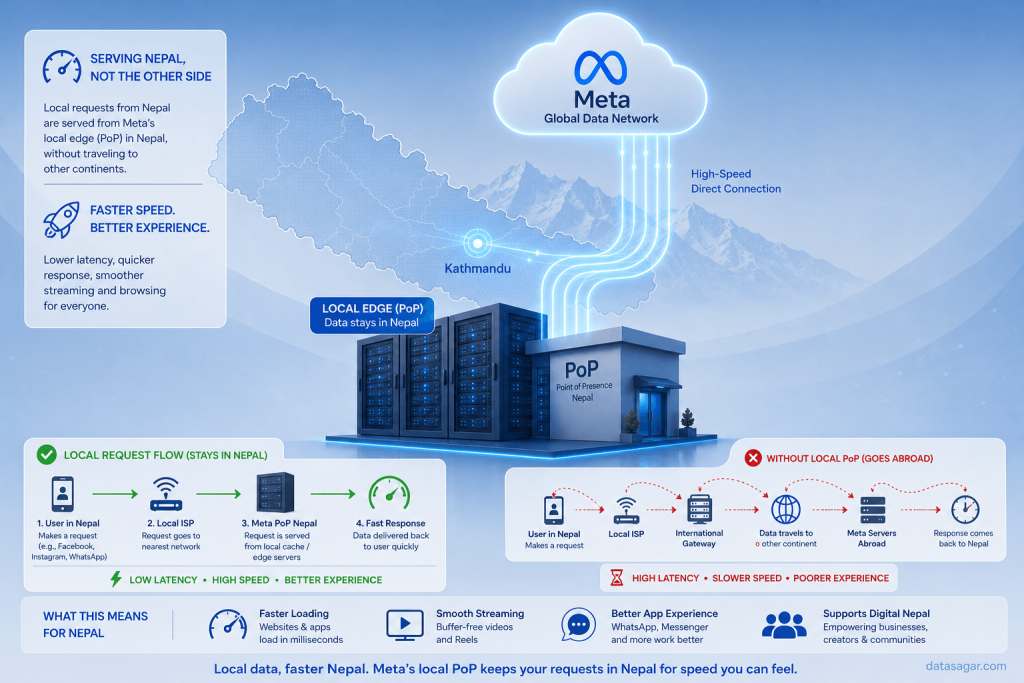
In a monumental milestone for Nepal’s digital ecosystem, tech giant Meta (parent company of Facebook, Instagram, WhatsApp, and Messenger) announced its plans to deploy a dedicated Point of Presence (PoP) infrastructure in Kathmandu by late 2026.
This decision represents a major leap forward: Meta is set to become the first global technology company to establish its own physical edge infrastructure inside Nepal.
The revelation was officially made during the SANOG 44 (South Asian Network Operators Group) conference hosted in Kathmandu, where industry leaders, internet service providers (ISPs), and network architects gathered to discuss the region’s routing and interconnectivity landscape.
1. What Triggered the Move? The SANOG 44 Announcement
At SANOG 44, Matt Jensen, representing Meta’s Network Investment team, outlined Meta’s architectural commitment to South Asia. Meta will partner with Data World to house hardware directly inside their enterprise-grade Tier-3 Data Center located in Matatirthha, Kathmandu.
Why SANOG 44 Matters
SANOG (South Asian Network Operators Group) is the regional forum where internet engineers and global content delivery networks (CDNs) establish peering standards, exchange points, and backbone architectures. Making this announcement at SANOG 44 signals to the regional technical community that Nepal is maturing from a consumer of cross-border bandwidth to a localized edge hub.
2. From Cache Nodes to Dedicated Infrastructure
To appreciate why this announcement is significant, it helps to understand the technical evolution of content delivery:
- The Old Approach (Distributed Cache Boxes): Historically, Big Tech platforms placed small software-based cache appliances—like the Facebook Network Appliance (FNA)—inside individual ISP server closets across Nepal. While this helped save some bandwidth, it was decentralized, fragmented, and limited in capacity.
- The New Approach (Dedicated Carrier-Neutral PoP): Meta is installing high-density, enterprise-grade physical hardware inside a dedicated, carrier-neutral Tier-3 Data Center (Data World in Matatirthha). This PoP functions as an authentic edge extension of Meta’s global core network.
3. The Bandwidth Math: 25% Down to 5%
Nepal imports vast amounts of international internet bandwidth, primarily via cross-border fiber connections through India.
- Current Status: Meta platforms currently account for ~1 Tbps of traffic, representing roughly 25% of Nepal’s entire international internet bandwidth intake.
- Post-Deployment Projection: Once the Matatirthha PoP is operational, media assets (HD video, Reels, live streams, Messenger content) will be served and cached locally. Meta’s share of imported international bandwidth is projected to drop sharply to ~5%.
What This Means for Local ISPs & Consumers
- Massive Cost Savings for ISPs: Local ISPs pay high recurring fees in foreign currency for international IP transit. Reducing Meta’s international transit share saves millions in foreign currency reserves.
- Reduced Latency & Elimination of “Tromboning”: Requests won’t need to route back and forth to servers in Singapore or India before delivering content to a user in Kathmandu or Pokhara.
- Buffer-Free User Experience: Video rendering, image loading, and real-time voice/video calls on WhatsApp and Messenger will see lower latency and reduced jitter.
4. Why Matatirthha? The Role of Tier-3 Data Centers
Establishing physical hardware requires world-class facility compliance. Data World’s Matatirthha Data Center provides:
- Tier-3 Standards: 99.982% guaranteed uptime with dual-powered cooling, redundant generator backup, and high-level physical security.
- Carrier Neutrality: Direct fiber interconnections to all major Nepali ISPs and the Nepal Internet Exchange (NPIX), ensuring open-peering access across the country.
5. The Big Picture: A Signal to Global Hyperscalers
Meta’s physical footprint in Matatirthha acts as a key indicator for the broader regional tech sector.
By proving that local data center facilities meet rigorous global operational requirements, Meta sets a precedent. This move is expected to encourage other global hyperscalers—such as Google, Cloudflare, Netflix, and major Cloud CDNs—to deploy dedicated hardware in Nepal rather than relying entirely on regional nodes in neighboring countries.
Summary Table
| Metric / Parameter | Before Meta PoP Deployment | After Meta PoP Deployment (2026+) |
| Meta Share of Int’l Traffic | ~25% (~1 Tbps) | Estimated ~5% |
| Architecture | Scattered ISP cache boxes (FNA) | Centralized Tier-3 PoP (Data World, Matatirthha) |
| Traffic Routing | Frequent cross-border international transit | Local intra-country peering via NPIX/Local Fiber |
| User Impact | Potential buffering during peak international congestion | Near-instant loading, low jitter, enhanced streaming |
For more technical breakdowns and deep dives into technology, internet architecture, and data engineering, stay tuned to DataSagar.